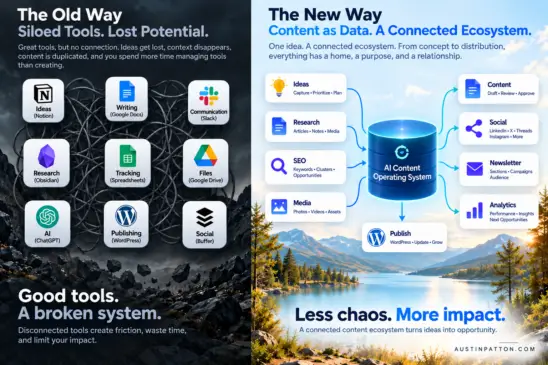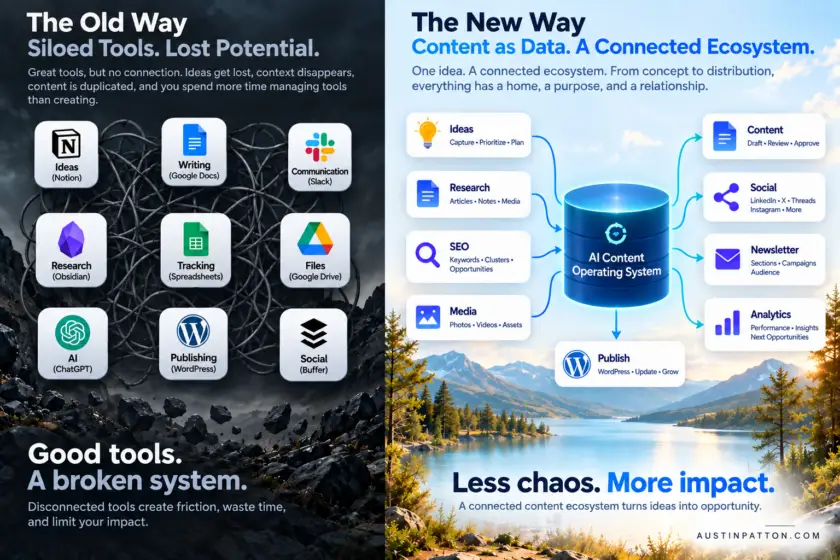
Running a website used to be relatively simple: write something, publish it, and move on.
That isn’t how I want to run AustinPatton.com.
As I started thinking seriously about what this site could become, I realized my biggest challenge wasn’t generating more content. I had ideas everywhere. The harder problem was turning those ideas into useful, high-quality content—and then managing everything that happens before and after I hit publish.
An idea might become an article. That article might need research, original photos, SEO work, a newsletter feature, and several social posts. Six months later, it might need to be updated because something changed.
I didn’t need another AI writing tool.
I needed a system.
So I started building my own AI content operating system: a custom platform that connects ideas, research, writing, media, SEO, publishing, and distribution while keeping a human firmly in control.
I’m building it for AustinPatton.com, but the underlying model could be useful for almost any entrepreneur trying to build a serious content platform without assembling a massive team.
And because I think the process is as interesting as the finished product, I’m documenting how it works.
The Problem With the Typical Content Stack
There are already great tools for almost every part of content creation.
You can keep ideas in Notion. Draft in Google Docs. Store research in Obsidian. Track production in a spreadsheet. Generate copy with AI. Manage images somewhere else. Publish in WordPress. Schedule social posts through another platform.
Individually, those tools can be excellent.
The problem is what happens between them.
Context gets lost. Files become disconnected from the content they support. An article gets published, but the original idea disappears into an archive. Social posts exist separately from the article that inspired them. Research gets duplicated. Old content becomes stale without anyone noticing.
Eventually, you spend more time managing the content machine than creating something worth reading.
I wanted to approach the problem differently.
Instead of asking, Which productivity apps should I connect?, I started asking:
What would the operating system for my content actually look like?
Content Should Be Treated as Data
That question led to one of the most important principles behind the system:
Content isn’t just text. It’s structured data with relationships.
An idea has a source, topic, priority, audience, content pillar, and potential value.
An article has a relationship to that idea. It also has a status, author, research, media, SEO strategy, publication history, social distribution, and potentially future updates.
Once those relationships are structured, AI becomes much more useful.
Instead of dropping a prompt into a chatbot and hoping it understands what I’m doing, the system can understand where a piece of content came from, what stage it’s in, what it’s supposed to accomplish, and what information it’s allowed to use.
That’s a fundamentally different model.
How My AI Content Operating System Works
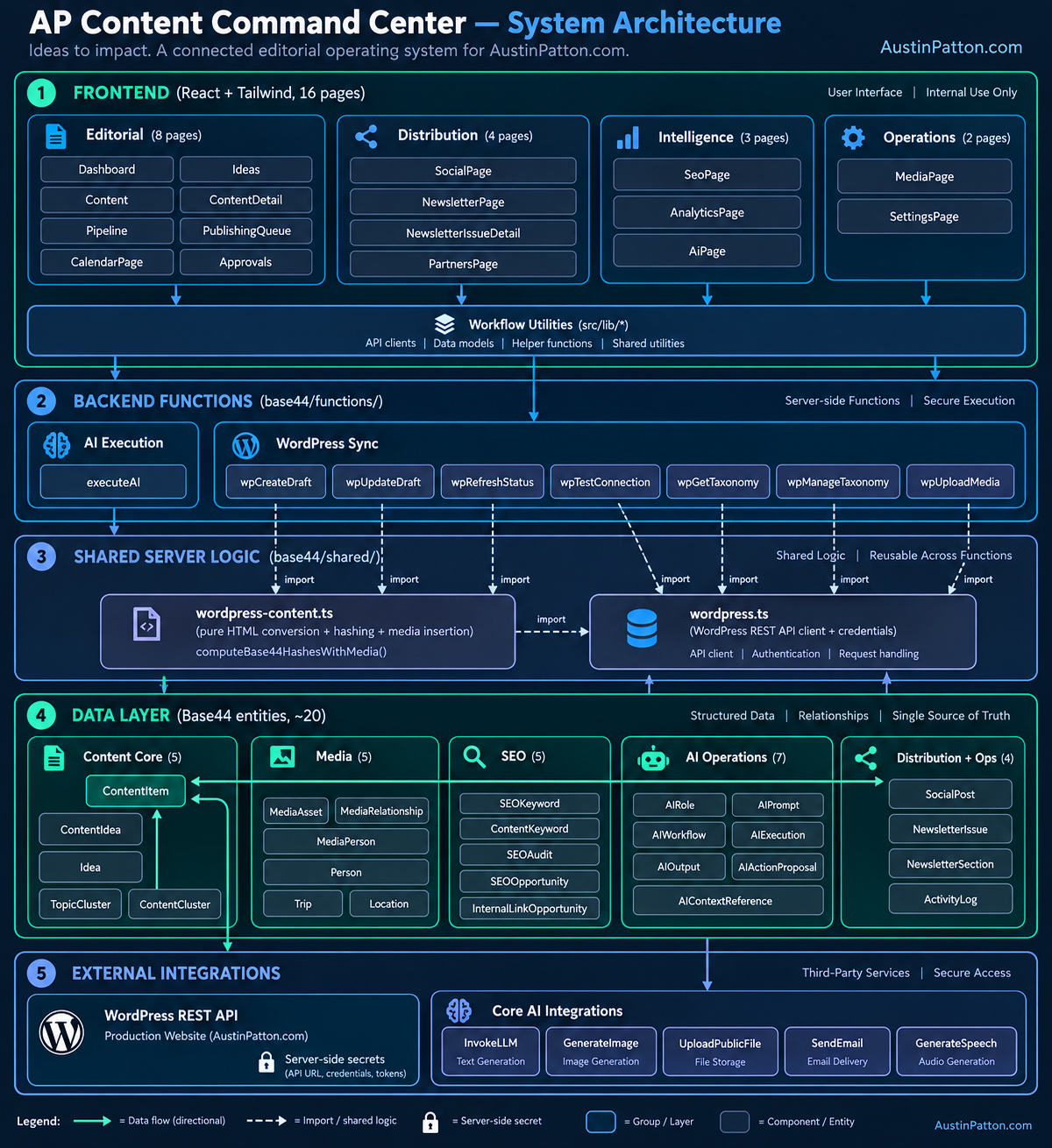
AustinPatton.com uses a hybrid architecture.
WordPress remains the public-facing publishing and SEO engine. It’s where the website lives and where finished content ultimately gets published.
Behind it, I’ve built the internal Content Operating System in Base44.
Base44 handles the structured database, authentication, editorial workflows, media archive, approvals, AI execution layer, and the relationships connecting ideas, articles, newsletters, social posts, SEO opportunities, and source material.
The two systems communicate through the WordPress REST API using secure server-side functions.
That means an approved piece of content inside my system can create or update a WordPress draft without exposing credentials in the browser.
But the interesting part isn’t really the API.
It’s what happens to an idea before it ever reaches WordPress.
From an Idea to an Entire Content Ecosystem
Inside the system, ideas begin as structured ContentIdea records.
That might sound unnecessarily technical, but the concept is simple: instead of throwing an idea into a notes app and hoping I remember it later, I give it a permanent home.
The system can track what the idea is about, who it might help, which content pillar it belongs to, how valuable it appears to be, and where it currently sits in the editorial process.
When an idea becomes something I’m actually developing, it moves into a ContentItem.
From there, the system can create and connect other records around it, including social posts, newsletter sections, media, SEO recommendations, and distribution opportunities.
The important word is connect.
I don’t want five pieces of content generated independently from the same prompt. I want one original idea to develop into a connected ecosystem while maintaining a record of where everything came from.
That’s provenance.
And I think provenance is going to become increasingly important as AI-generated information floods the internet.
I Gave the AI Jobs, Not Unlimited Access
Another lesson emerged while I was building the system: I didn’t want one giant AI assistant doing everything.
So I created specialized roles.
There’s an Archivist responsible for helping organize and understand the information already in the system.
A Story Hunter looks for potentially valuable stories hiding inside that information.
The Editor-in-Chief evaluates ideas and editorial direction.
The Content Producer helps transform approved ideas into content.
The Publisher assists with the publishing workflow.
And the Analyst looks at performance and opportunities after publication.
These aren’t autonomous employees running AustinPatton.com while I sit on a beach somewhere.
They’re specialized AI functions with defined responsibilities, permissions, and boundaries.
That distinction matters.
Human-in-the-Loop Isn’t a Limitation
There’s an understandable temptation when building with AI to automate everything possible.
I’m deliberately not doing that.
AI inside my Content Operating System can discover, organize, recommend, analyze, synthesize, and draft. It can eliminate a tremendous amount of repetitive work.
But consequential decisions still belong to me.
AI doesn’t get the final say on what I publish. It doesn’t independently decide questions involving privacy, rights, or the integrity of my records. And it doesn’t get to quietly change the strategic direction of the platform because an algorithm decided something might perform better.
That’s not inefficiency.
Human judgment is part of the architecture.
The goal isn’t to remove myself from content creation. The goal is to remove enough friction that I can spend more time on the parts where my experience, judgment, curiosity, and voice actually matter.
Why Provenance May Become a Competitive Advantage
We’re entering an internet where producing enormous quantities of technically competent content is becoming almost trivial.
That changes what creates value.
I don’t think the long-term advantage will belong to whoever can generate the most articles.
It will belong to people who can produce things that are useful, trustworthy, original, and connected to genuine experience or expertise.
That’s one reason I’m building provenance into the system from the beginning.
I want to know where an idea came from.
I want source media connected to the stories it supports.
I want AI-generated recommendations distinguishable from human decisions.
I want important actions to require approval.
And I want the system to preserve those relationships as AustinPatton.com grows.
Transparency isn’t something I want to bolt on later. It’s part of the infrastructure.
What I’d Recommend to Other Entrepreneurs
You don’t need to recreate my exact technology stack to build an AI content operating system.
In fact, I wouldn’t start with the technology at all.
Start by mapping how information moves through your business.
Where do ideas originate? What determines whether an idea is worth pursuing? What information does someone need before creating something? What happens after publication? Which decisions could safely be assisted by AI? Which decisions should always remain human?
Then identify the relationships you keep losing.
Those relationships are probably more important than whatever AI model you choose.
You can build the world’s most sophisticated automated writing pipeline and still end up with a terrible content operation if the system doesn’t understand why something is being created, who it’s for, where its information came from, and what should happen next.
The Bigger Experiment
AustinPatton.com has become more than a website redesign for me.
It’s an experiment in how one person can use AI and custom software to operate something that would traditionally require a much larger content organization.
I’m not trying to automate creativity.
I’m trying to build infrastructure around it.
If it works, the result won’t simply be that I can publish more.
I’ll have a system capable of remembering what I’ve created, finding opportunities inside what I already know, maintaining connections between ideas and outputs, helping distribute useful work, measuring what actually resonates, and continuously improving the process—without surrendering editorial judgment to the machine.
That’s what I mean when I call it an AI content operating system.
And as I continue building mine, I’ll keep documenting the architecture, experiments, failures, and lessons here so other entrepreneurs can take what works, avoid what doesn’t, and perhaps build something even better.
Useful Links
The WordPress REST API provides an interface for applications to interact with your WordPress site by sending and receiving data as JSON (JavaScript Object Notation) objects.
Learn more here: https://developer.wordpress.org/rest-api/
What will you build? Everything you need to build with Base44, from your first prompt to launch.
Learn more here: https://docs.base44.com/